
Helping Organizations Achieve Their Goals
Increasing aligned objectives from 0.02% to 17% — an 85,000% growth.
7Geese (now Paycor Talent Development) started out purely as a goal-setting product. As it grew to serve a wider and more diverse customer base, the product accumulated complexity that it wasn't built to handle.
I led the end-to-end redesign of the flagship feature, Objectives Creator — from domain research through concept testing, usability validation and launch. It was one of 7Geese's biggest success stories that ultimately contributed to our acquisition in 2020.
Challenge
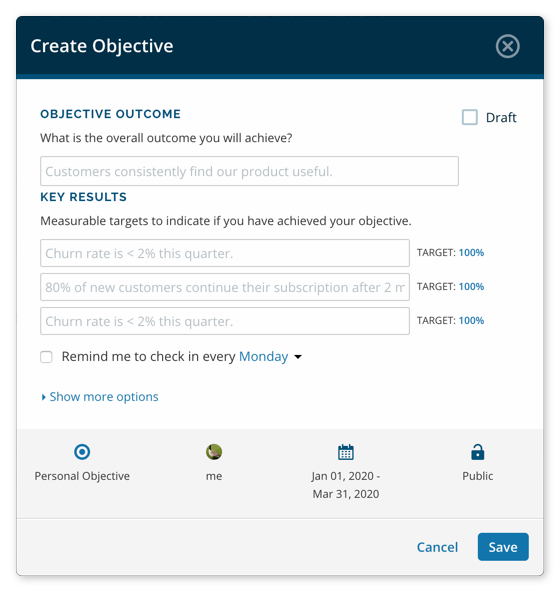
The previous Objectives Creator assumed users already knew what their goals were and understood the OKR methodology, which was the framework we used.
User feedback made the gap explicit:
"The process for creating OKRs is not intuitive."
"I don't find it particularly easy to pin down measurable objectives."
"…inserting the objectives are not really clear."
With competing products entering the market, maintaining the platform's edge meant making setting goals genuinely accessible, not just functional.
Discovery
Domain Research
I'm not an OKR expert, so the first step was to learn about this methodology. Before touching any design work, I read Measure What Matters by John Doerr and Radical Focus by Christina Wodtke — both regarded as the essential texts on OKR. I also met with our in-house experts to gain hands-on knowledge of how the framework plays out in practice.
User Archetypes & Journey Mapping
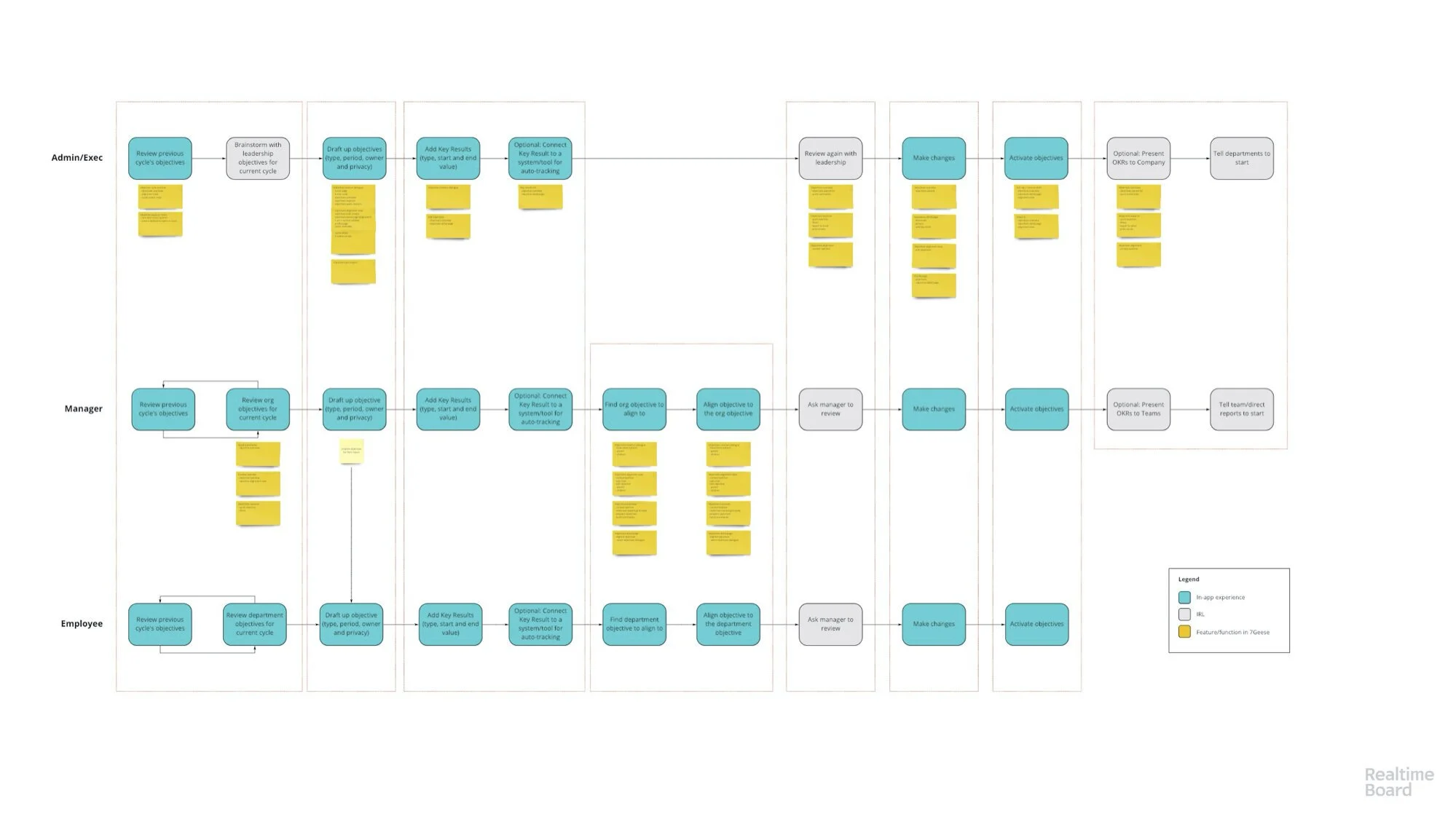
7Geese's customers span a wide range of company types and sizes. I worked with the team to define three distinct user archetypes and map their specific roles in the OKR process — reflecting both the top-down and bottom-up nature of how objectives get created and aligned across an organization.
Baseline Metrics
I pulled usage data from Pendo to establish a pre-launch baseline. This required some setup: OKRs follow seasonal business cycles (annual and quarterly) and those cycles don't always align to the calendar year. Getting the measurement framework right before launch was essential to reading the results accurately later.
Definition
The research pointed to a clear problem: we had been assuming expertise that most users didn't have. The opportunity was to design a creator that could educate and guide users through a genuinely complex process — not just clean up the UI.
Ideation
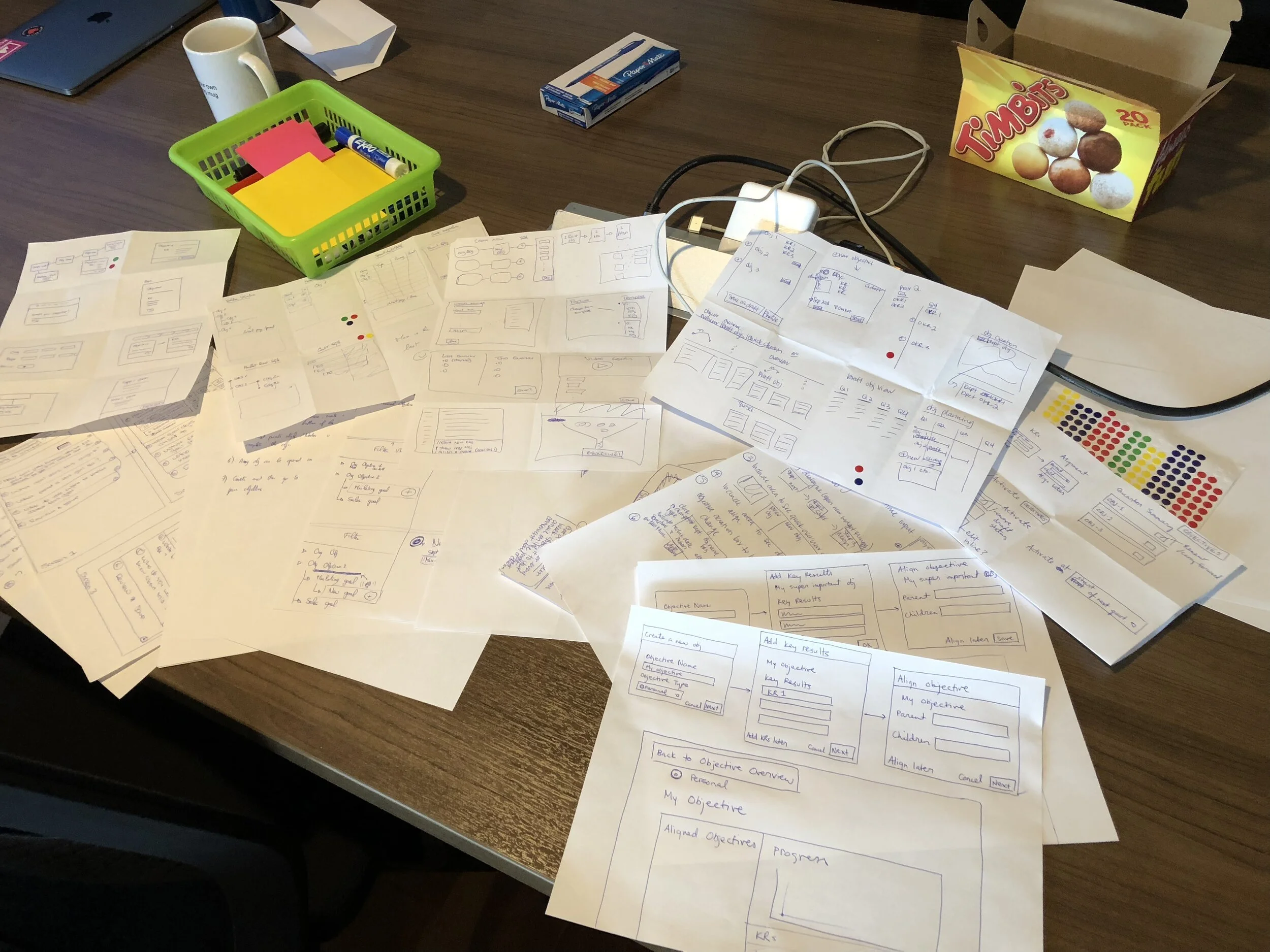
The ideation phase opened with a design workshop. I presented discovery findings to the team and stakeholders, then facilitated a Crazy 8s sketch exercise that generated over 60 ideas in a single afternoon. From that output, we selected five distinct concepts — each representing a different user mental model for how objective creation might work.
Validation
Concept Testing
I ran a structured concept test with a select group of users. Participants rated each concept on ease of use (quantitative) and ranked them by preference, with qualitative feedback providing context for the numbers.
The form concept resonated most and the wizard pop-up format was a consistent nice-to-have. Both scored high on ratings and rankings. The outcome highlighted one important insight: OKR creation is inherently sophisticated. The old creator was too simplistic.
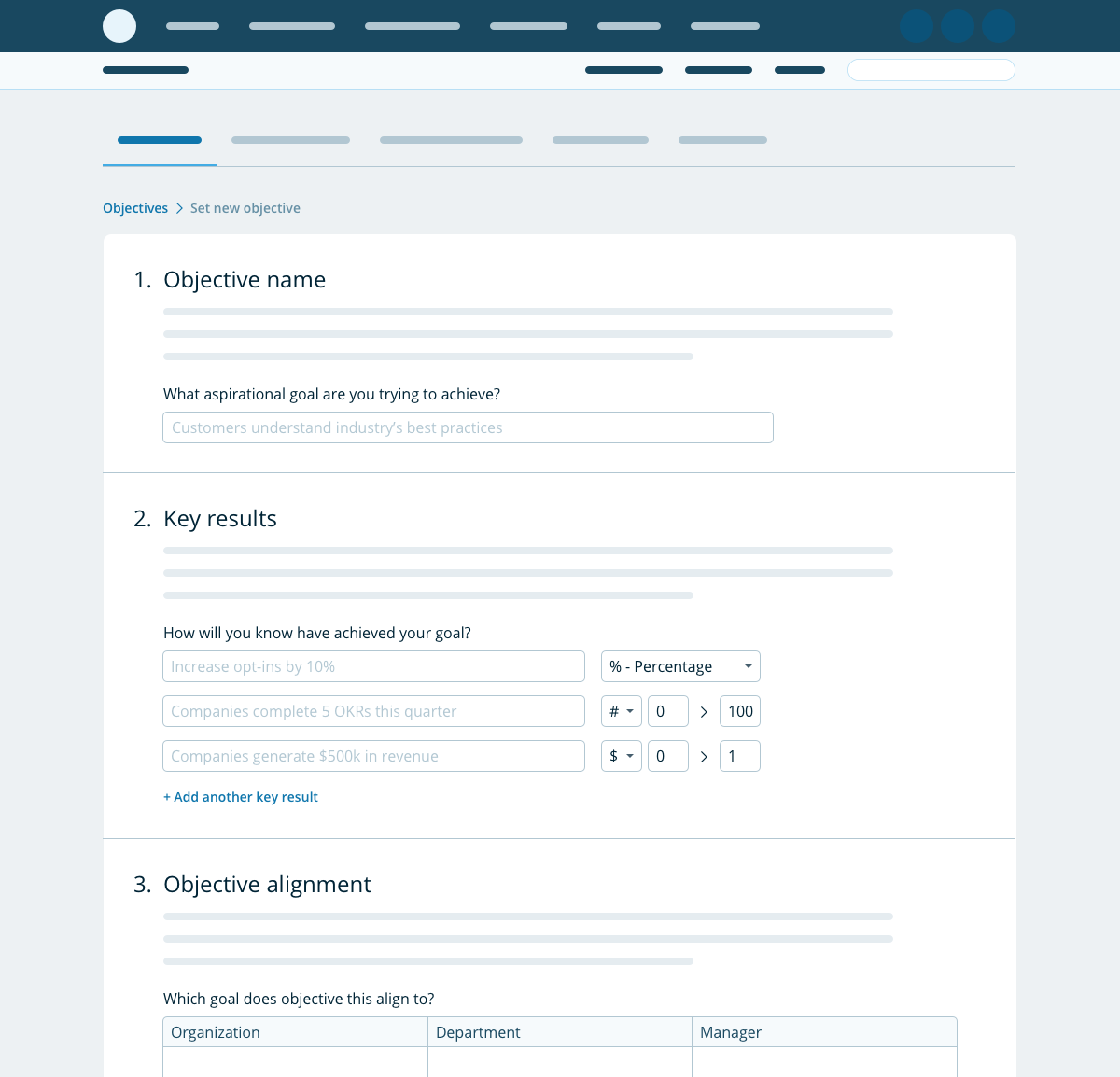
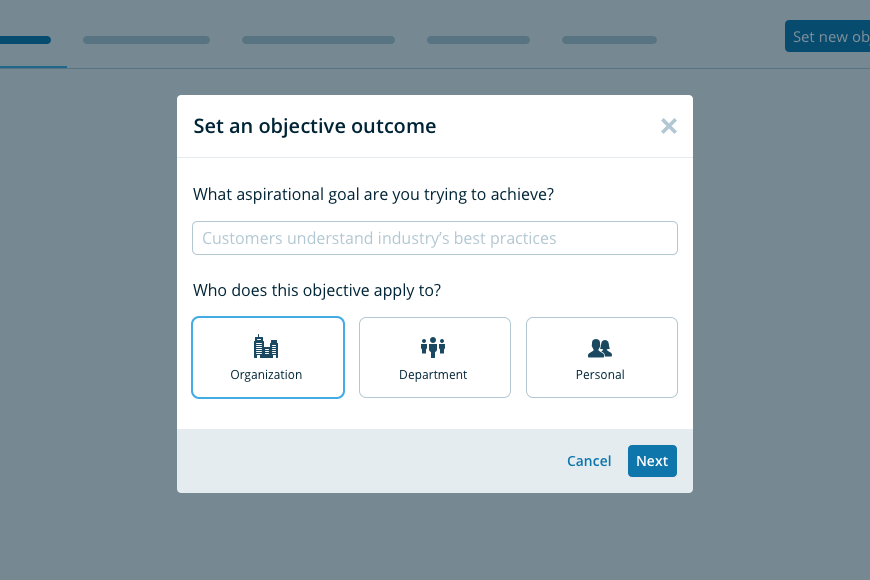
I brought the findings and design recommendations back to the team, then did a feasibility gut-check with engineering. The form concept emerged as the most viable path. With its modular approach, we could break it down and ship in smaller iterations.
Usability Testing
Nine participants completed scenario-based tasks scored on the System Usability Scale. The average came in at 80 out of 100 — with users describing the new experience as more intuitive despite being simple like the old creator.
The standout finding: no two customers approached goal setting the same way. That reinforced the modularity decision.
Launch
Given that this was a flagship feature, we launched the new Objectives Creator through a beta program. Here are the most common pieces of feedback:
"Perfectly fits our needs! We are just starting to use OKRs and the tool is easy to use and the right fit for busy people."
"Useful interface! I can see other OKRs while creating mine."
"Easy to use, intuitive, links OKRs nicely."
Outcome
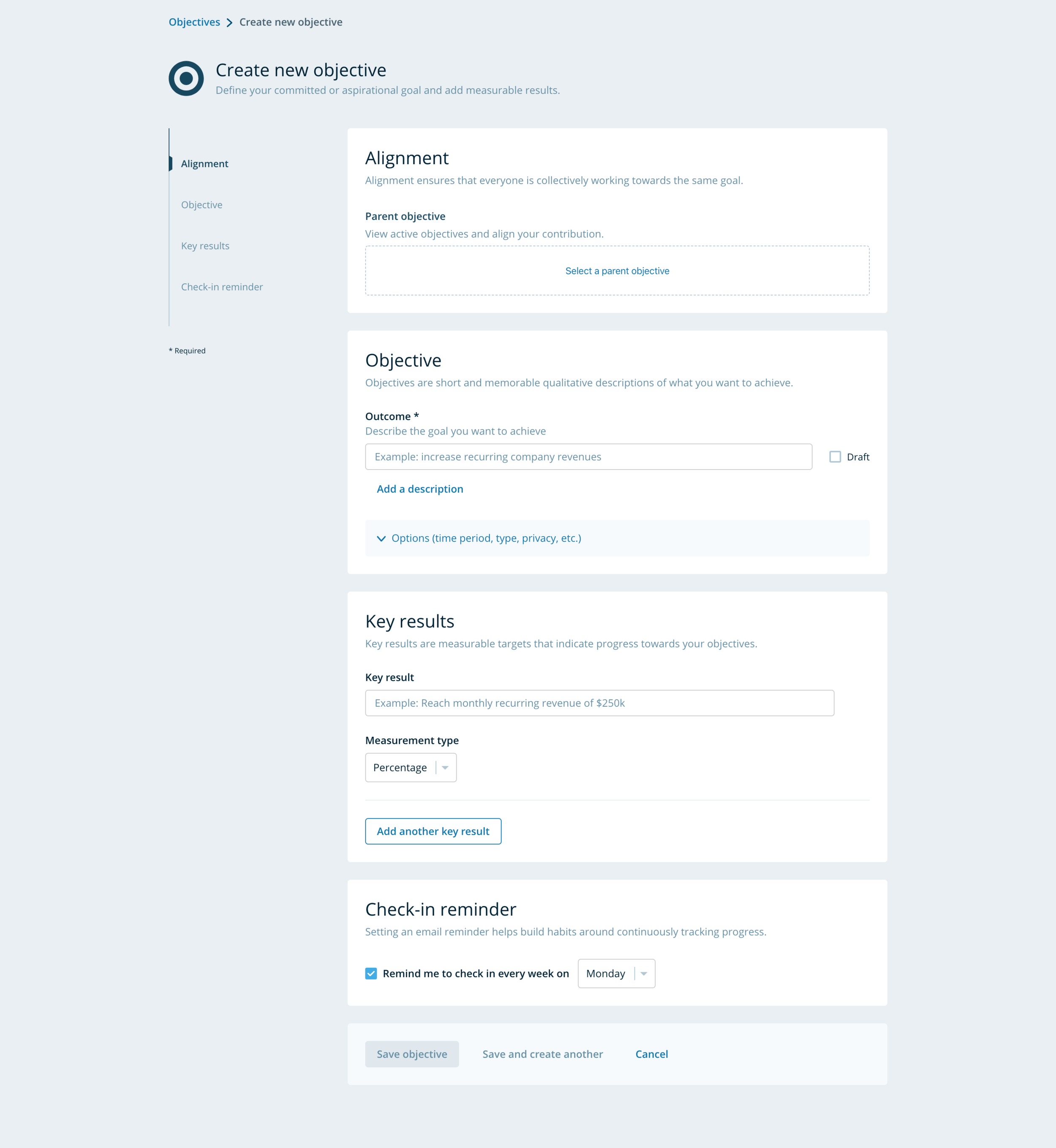
Aligned objectives increased from 0.02% to 17% — a whopping 85,000% growth.
Alignment of objectives is the key to success for every goal. It also ensures product stickiness. Overall, it was an amazing journey coming from understanding the subject and problem space to releasing an uber effective solution. Research played a key role in defining the most viable direction. And most importantly, it was trust in our team that made this design vision into reality.